The Evolution of My Storage Systems
Five generations of 3D-printed organisation — from Alexandre Chappel's drawer boxes to openGrid. Each iteration taught me something, and each limitation drove the next step forward.
The Journey
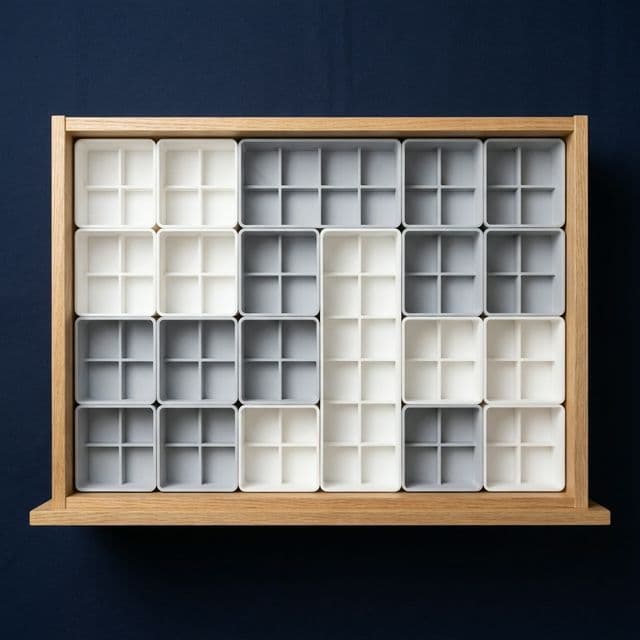
Alexandre Chappel Grid
by Alexandre Chappel
“The one that started it all”
What it solved
Before Alexandre Chappel, 3D-printed storage was ad-hoc — one-off boxes with no shared standard. Chappel introduced the idea of a modular assortment system: a family of boxes that nest together in drawers and on shelves. He proved that 3D printing could move beyond novelty trinkets into genuinely useful household infrastructure.
Where it fell short
The system was largely proprietary — paid files, no universal grid standard and no community-driven expansion. If a specific size or accessory didn't exist, you were stuck. It also focused exclusively on horizontal (drawer/shelf) storage, ignoring walls entirely.
Chappel showed me the potential. A drawer full of perfectly fitted boxes is deeply satisfying — but I wanted something open, expandable and community-driven.
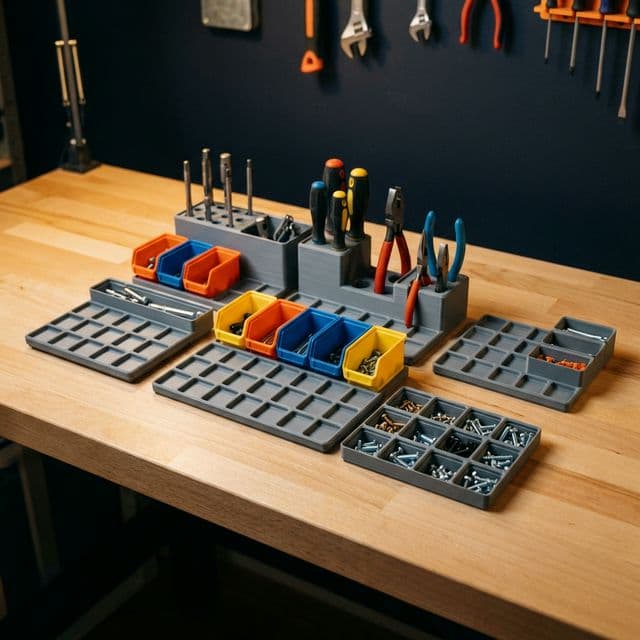
Gridfinity
by Zack Freedman
“The open-source revolution”
What it solved
Gridfinity took Chappel's concept and made it open-source with a standardised 42 × 42 mm grid. Suddenly anyone could design compatible bins, holders and jigs. The community exploded — thousands of parts appeared on Printables and MakerWorld practically overnight. It became the gold standard for desk and drawer organisation.
Where it fell short
Gridfinity is fundamentally a horizontal system. It sits on flat surfaces — desks, shelves, drawers. It has no native wall-mount capability. For anyone with limited desk space (like me), I needed walls to work just as hard as my benchtop.
Gridfinity is still my go-to for every horizontal surface in the house. The ecosystem is unbeatable. But it only solved half the problem — I still had bare walls.
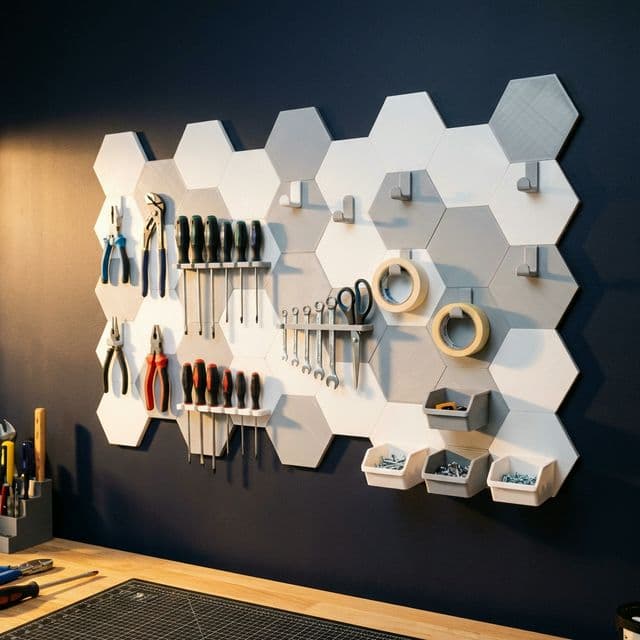
HSW (Honeycomb Storage Wall)
by RostaP
“Walls finally got a grid”
What it solved
HSW was the first widely adopted 3D-printed wall storage system. Interlocking hexagonal panels give you a surface to hang tools, tape, scissors — anything that's better on a wall than in a drawer. It proved that vertical surfaces could be organised with the same modular thinking as horizontal ones.
Where it fell short
The honeycomb geometry looks beautiful but limits what you can attach — accessories must conform to hex cells, which makes parametric design harder. Weight capacity is modest. And critically, it's not open-source — customisation requires OpenSCAD and a lot of patience.
HSW opened my eyes to wall storage, but I constantly bumped into its shape constraints. I wanted a simpler, stronger, more flexible grid.
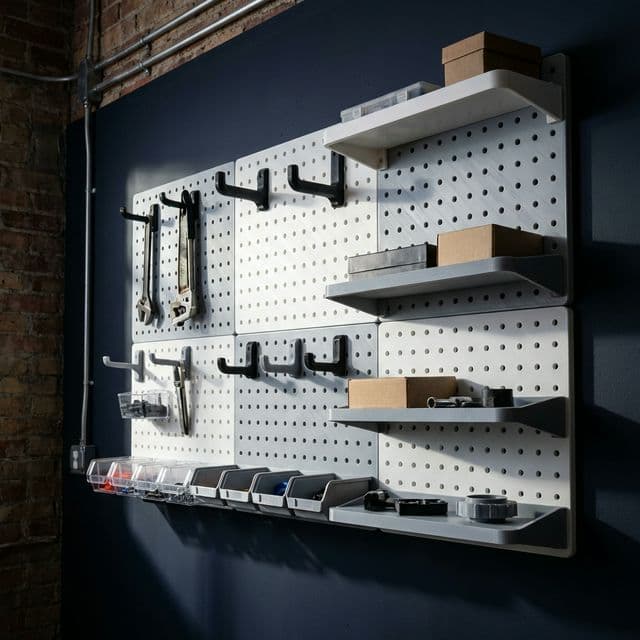
Multiboard
by Multiboard.io
“Industrial strength, parametric design”
What it solved
Multiboard replaced the hex cell with a square peg-hole grid and massively increased strength — each peg reportedly holds ~20 kg. The parametric tile system means you can generate any size board to fit your wall. It's visually clean and mechanically robust, with a growing library of bins, hooks and shelves.
Where it fell short
Multiboard is not open-source — the core files are proprietary. It also operates in its own silo: Multiboard parts don't work with Gridfinity, and vice versa. If you're invested in Gridfinity on your desk, you now have two completely separate ecosystems to manage.
Multiboard is excellent engineering. But I don't want to live in two incompatible worlds — one for my desk and one for my walls. That friction is what drove me to build openGrid.
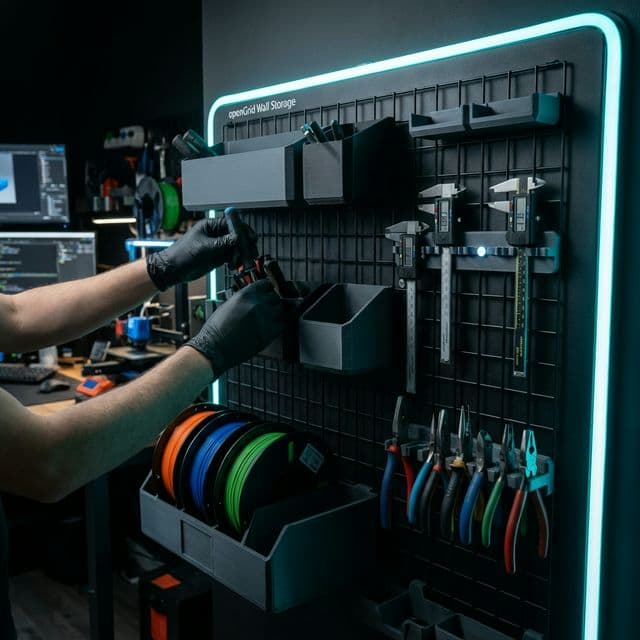
openGrid
by Hands On Katie
“One system. Every surface. Open forever.”
What it solved
openGrid was designed to end the fragmentation. It's fully open-source (CC-BY), uses a simple snap-fit peg mechanism, and is natively backwards-compatible with both Gridfinity and Multiboard accessories. It works on walls and desks. One standard, one ecosystem, every surface in the house.
Where it fell short
It's still young — the parts library is growing but smaller than Gridfinity's. And because it's my own project, it carries an inherent bias. But openness is the antidote: anyone can contribute, fork, or improve it.
This is where I am today. openGrid is the system I wanted from the start — modular, open, universal and beautiful. Everything I learnt from the previous four generations went into it.
My Organisational Ethos
Five generations of trial and error distilled into five principles. These are the non-negotiables that guide every decision I make about home organisation.
Interconnected
Universal compatibility over proprietary lock-in.
Aesthetics
Beauty and modularity over function alone.
Open
Shared standards over walled gardens.
Simple
Complexity is a failure of design.
Multi-material
Use the right materials for the job, not just plastic monoculture.
The Right System for Every Surface
No single system does everything. The key insight from five generations is that each surface type demands a different approach — but they should all share a common philosophy.
Ready to Start Organising?
Explore the full home organisation hub, or jump straight to openGrid and download your first parts for free.